
Suppliers Raise Prices 5-8% When You're Not Looking — Here's How to Catch It
BCG research: suppliers increase prices 5-8% on extended terms. With retail margins at 3-10%, see how independent retailers catch $5,000-$25,000 in hidden overcharges annually.
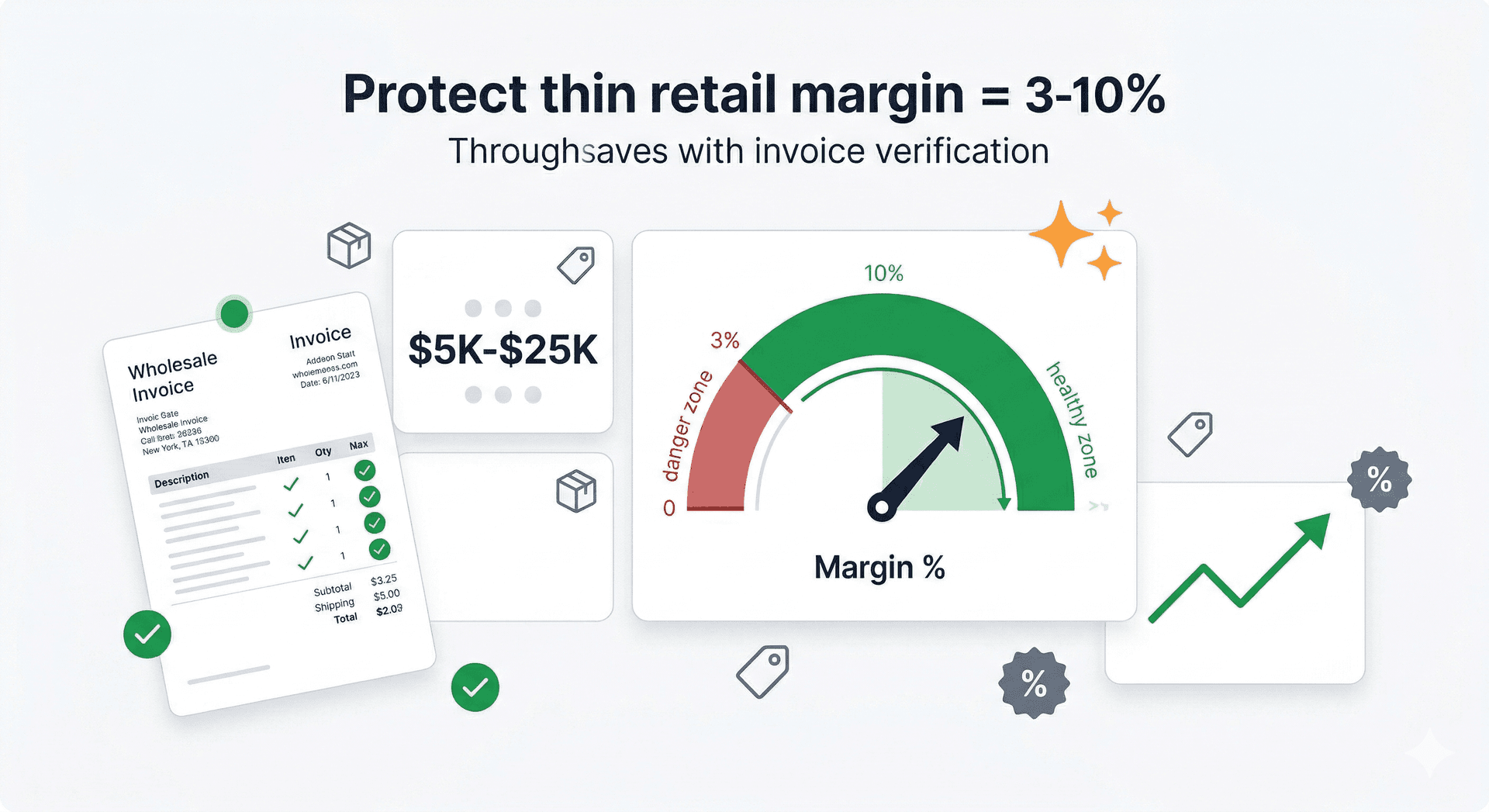
Jason Kim knew he was probably overpaying somewhere across his 28 suppliers, but he didn't have time to check every invoice. When he finally ran a systematic comparison, he found $8,400 in overcharges in the first quarter alone. BCG research confirms the pattern: suppliers increase prices 5-8% when they think you're not checking. On $500K annual wholesale, that's $25K-$40K in quiet overcharges—devastating to margins of just 3-10%.
Key Statistics at a Glance:
| Metric | Value | Source |
|---|---|---|
| Annual retail shrinkage (US) | $132 billion (2024) | NRF/Industry Research |
| Supplier price creep on extended terms | 5-8% increase | Boston Consulting Group |
| Retail inventory accuracy (US) | 63% | Shopify / retail research |
| Average retail profit margin | 3-10% | Industry consensus |
| Estimated wholesale overpayment rate | 1-5% annually | Industry benchmarks |
| More discrepancies found with AI vs manual | 27% | TRO Matcher platform data |
Key Takeaways
"Retail shrinkage — including vendor fraud and administrative errors — is now a $132 billion problem in the United States." — National Retail Federation 2024
"Suppliers increase prices by 5-8% when payment terms are extended beyond industry norms, often without explicit notification." — Boston Consulting Group
Retailers who switch from spot-checking to verifying every invoice consistently find discrepancies they'd otherwise miss—the difference between reviewing 40% of invoices and reviewing 100%.
"Inventory accuracy in U.S. retail operations is only 63%, and correcting these discrepancies lifts sales by approximately 11%." — Retail inventory research across 24,000 SKUs
"Retailers spend 25-35% of their total budget on inventory costs — the single largest controllable expense for most independent stores."
With retail profit margins averaging just 3-10% and specialty retailers facing higher risk of restructurings in 2026, every dollar lost to supplier overcharges comes directly off your bottom line. Yet most independent retailers still verify wholesale invoices the same way they did a decade ago: manually, in spreadsheets, one line item at a time.
The Hidden Margin Killer: Suppliers raise prices 5-8% when payment terms are extended without negotiation (BCG 2024). On $500K in annual wholesale purchases, that's $25K-$40K in quiet overcharges — and with margins at 3-10%, you'd need $250K-$400K in additional sales just to recover what you're silently losing.
What retail owners discovered:
"A ceramic supplier had been charging us 6% above the agreed price list for five months. That one catch covered the full year's subscription cost." — Amanda Wright, Owner, Meadow & Vine Gift Shop, Surrey
"I knew I was probably overpaying somewhere across 28 suppliers, but I didn't have time to check every invoice. Found $8,400 in overcharges in the first quarter." — Jason Kim, Owner, Coastal Living Home Store, Brighton
Q: What is AP automation and does TRO Matcher provide it? A: AP automation digitizes invoice processing from receipt to payment. Invoice capture tools like Hubdoc and Dext focus on extraction. TRO Matcher provides the core function SMBs need: AI invoice extraction and comparison with CSV export to QuickBooks and Xero — plus vendor comparison features not found in extraction-only tools.
Q: What is line item matching in invoice verification? A: Line item matching compares individual products against the original order and quoted prices — not just invoice totals. This catches per-item overcharges like "$12.99/lb billed instead of $11.99/lb quoted". TRO Matcher extracts and matches line items in under 60 seconds using Google Gemini AI.
Contents
- Why are retailers overpaying wholesale suppliers?
- What does wholesale overpayment actually cost your store?
- How does AI invoice comparison catch pricing discrepancies?
- Five strategies to stop overpaying wholesale suppliers
- For accountants and bookkeepers serving retail clients
- Your data, your control: GDPR Article 20 compliance
- TRO Matcher vs. alternative solutions
- How One Gift Shop Cut Wholesale Costs by 8.4%
- Frequently asked questions
Where Retail Margins Leak
Independent retailers face a procurement challenge that big-box chains solved years ago with enterprise software: verifying that every invoice matches what was quoted, ordered, and delivered. Without dedicated procurement staff, most small retailers default to spot-checking — reviewing a handful of invoices and trusting the rest.
The problem is structural. Small retailers typically manage 15-40 wholesale suppliers simultaneously, each with their own pricing tiers, volume discounts, seasonal promotions, and payment terms. When you're also managing the shop floor, staff scheduling, and customer experience, invoice verification becomes the task that "can wait."
The most common sources of wholesale overpayment:
| Source | How It Happens | Typical Impact |
|---|---|---|
| Price creep | Supplier raises prices between quotes and invoices | 2-5% above agreed rate |
| Volume discount errors | Discount tier not applied at correct threshold | 3-10% of qualifying orders |
| Duplicate charges | Same shipment invoiced twice, often weeks apart | 1-3% of invoices affected |
| Unit pricing mistakes | Per-case vs per-unit vs per-pallet inconsistencies | $50-$500 per error |
| Missing promotional pricing | Seasonal discounts not reflected on invoice | Full price vs 10-25% off |
| Freight and handling overcharges | Carrier rates higher than contracted | 5-15% above agreed freight rates |
Source: Industry benchmarks from IHL Group and AP automation research
According to the National Retail Federation 2024, vendor-related losses — categorised under "vendor fraud" and "administrative errors" — are documented contributors to the $132 billion annual retail shrinkage problem in the United States. While shoplifting dominates the headlines, quiet overcharges from suppliers drain margins just as effectively.
"Most small business owners are at companies that earn $5 million or less and have small teams of five or fewer employees." — Capterra retail research
That's exactly the profile where invoice errors go unchecked — not because the owner doesn't care, but because there aren't enough hours in the day.
Check your wholesale invoices. Retailers find an average of £8,400 in Q1 overcharges. Upload your supplier invoices and see what your spreadsheet missed.
What Does Wholesale Overpayment Actually Cost Your Store? ($5,000-$25,000 Annually)
The maths is straightforward but alarming when you see it on paper. Consider a typical independent retail store:
Annual wholesale overpayment impact by store size:
| Store Profile | Annual Wholesale Spend | Overpayment Rate (2%) | Overpayment Rate (5%) | Hours Lost to Manual Checks |
|---|---|---|---|---|
| Small boutique (1-2 staff) | $150,000 | $3,000 | $7,500 | 4-6 hrs/week |
| Independent retailer (3-10 staff) | $500,000 | $10,000 | $25,000 | 8-12 hrs/week |
| Multi-location (2-5 stores) | $1,500,000 | $30,000 | $75,000 | 15-25 hrs/week |
For a retailer with $500,000 in annual wholesale purchases and a 5% net profit margin, $10,000 in undetected overpayments represents the equivalent profit from $200,000 in additional sales. Put differently: you'd need to sell $200,000 more merchandise just to cover what you're losing to supplier invoice errors. With average retail profit margins of 3-10%, there's almost no buffer for undetected supplier overcharges.
The hidden cost multiplier:
Wholesale overpayment doesn't just cost you the overpaid amount. It cascades:
- Inflated COGS — Your cost of goods sold rises, compressing margins on every item
- Mispriced inventory — Retail prices based on wrong wholesale costs lead to under-pricing or overpricing
- Distorted purchasing decisions — You might stop ordering from a "more expensive" supplier who is actually cheaper once you correct the invoice errors
- Cash flow pressure — Overpaying ties up working capital that could fund marketing, staffing, or new inventory
- Tax implications — Overstated inventory costs affect your tax position
"Carrying costs account for about 25% of a given company's total inventory costs, and that percentage can climb to 40% in some cases." — Procurement Tactics
According to Procurement Tactics, carrying costs alone represent 25-40% of total inventory value. When your wholesale cost basis is inflated by even 2-3%, the ripple effect on carrying costs, pricing, and profitability compounds throughout the entire business cycle.
How Does AI Invoice Comparison Catch Pricing Discrepancies?
Traditional invoice verification requires a retailer to manually enter line items from each supplier invoice into a spreadsheet, then cross-reference against the original purchase order or price list. For a store receiving 50-100 invoices monthly, this process alone consumes 15-25 hours per month.
AI-powered invoice comparison eliminates the manual step entirely:
Step-by-step: wholesale invoice comparison with TRO Matcher
- Upload — Photograph or upload your wholesale supplier invoice in any of 8 formats (PDF, PNG, JPEG, WebP, HEIC, CSV, DOCX, XLSX)
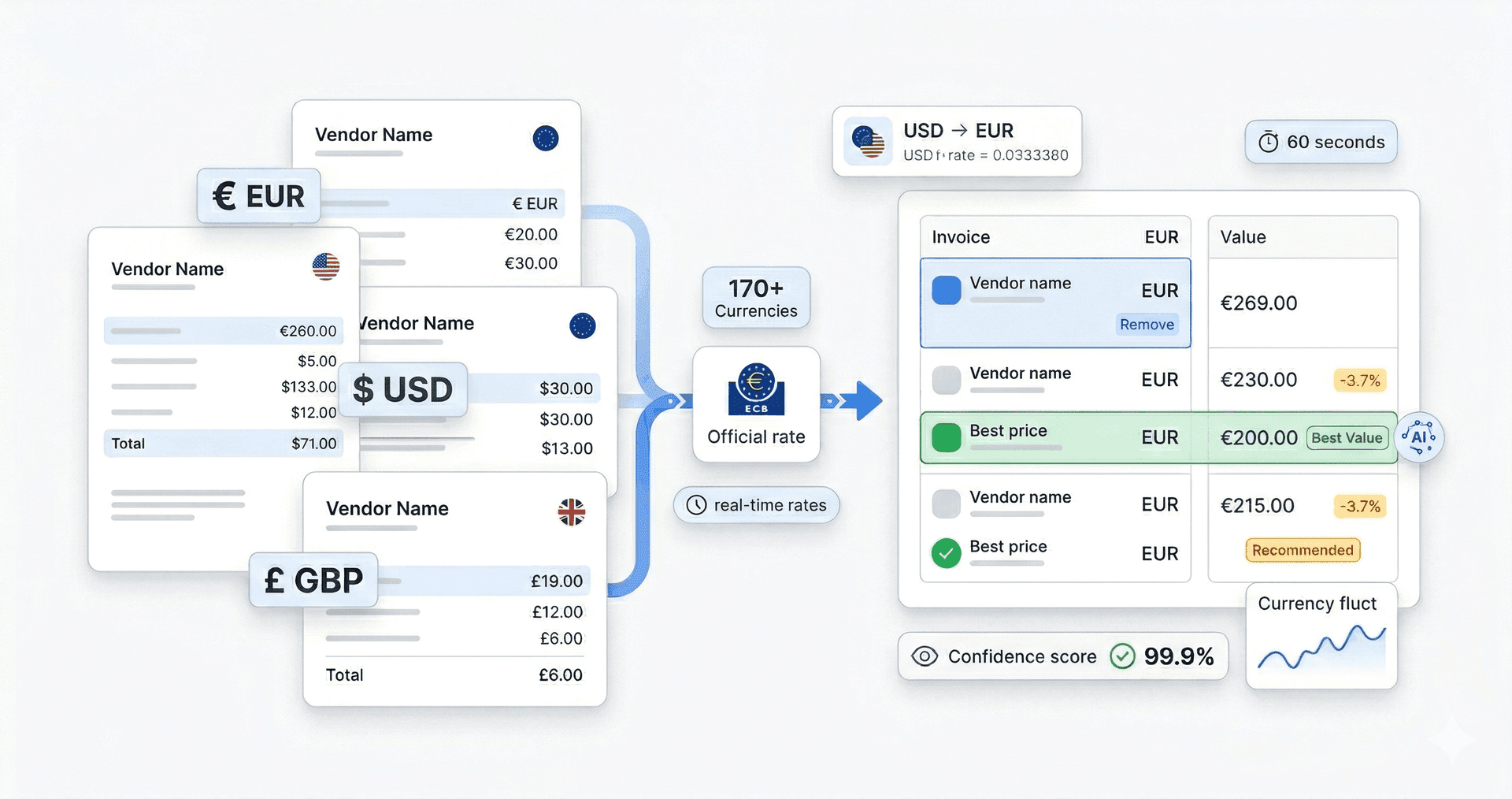
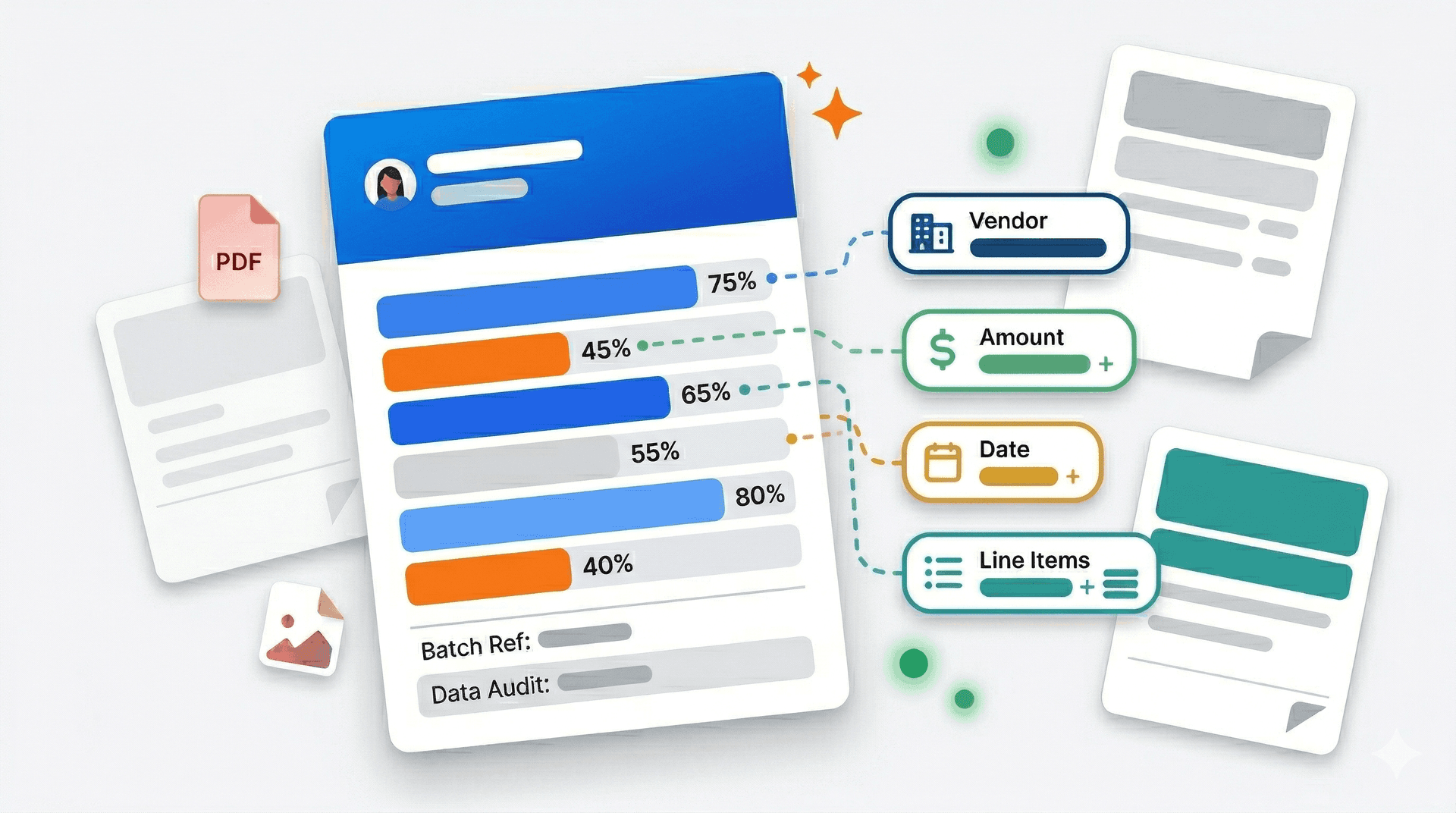
- Extract — AI extracts every line item, unit price, quantity, discount, and total in under 60 seconds with confidence scores on every field
- Review — Check extracted data with field-level confidence scores so you know exactly what to verify
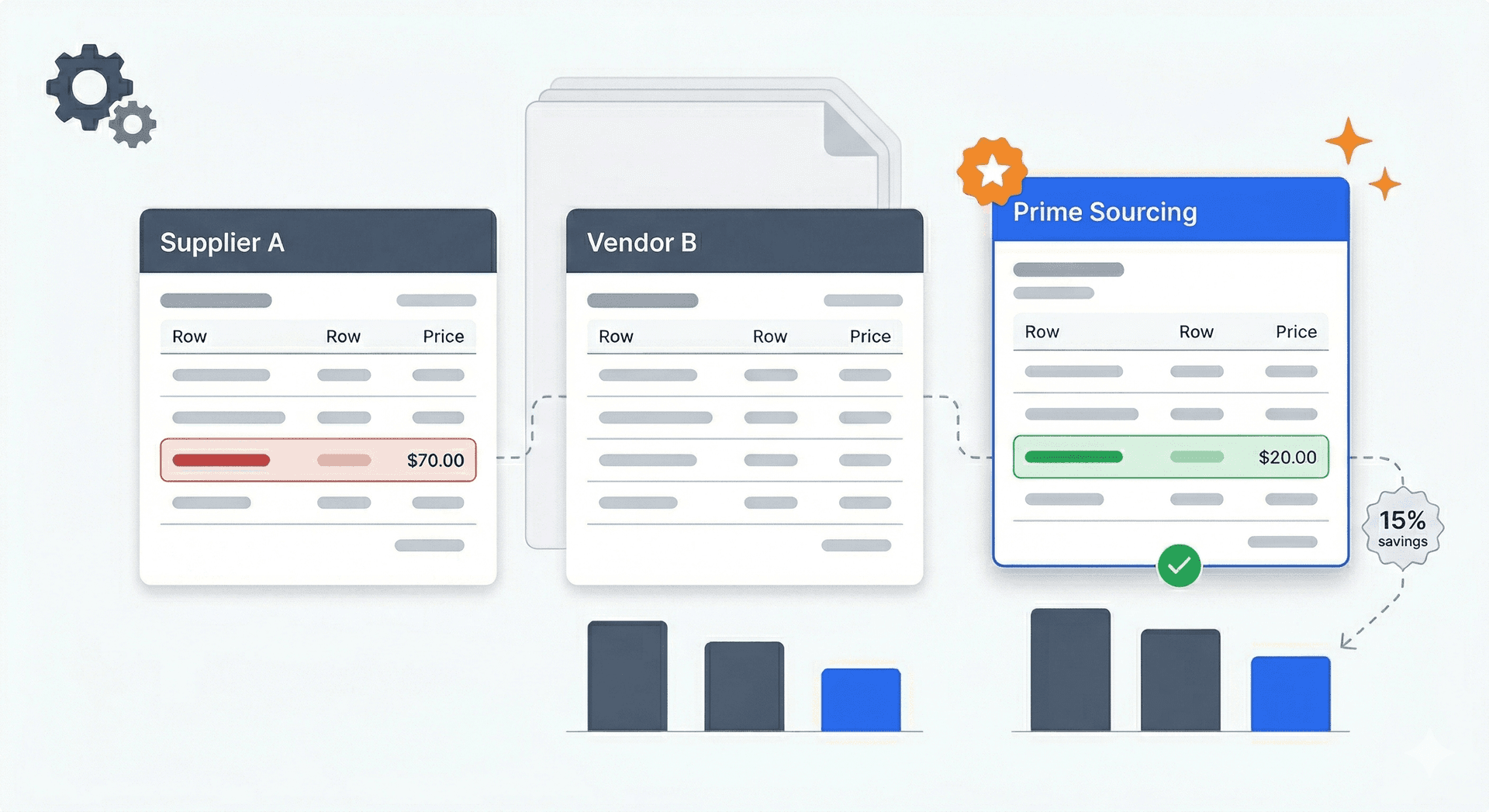
- Compare — Upload the competing quote or previous invoice and get a side-by-side comparison highlighting every price variance
- Decide — AI ranks invoices by price, payment terms, and data completeness to recommend the best-value supplier
- Export — Download results as CSV for QuickBooks/Xero import or as PDF for your records
Time comparison: manual vs AI for common retail tasks
| Task | Manual Method | AI Method (TRO Matcher) |
|---|---|---|
| Extract data from 1 wholesale invoice | 15-20 min | Under 60 seconds |
| Compare 3 supplier quotes | 45-60 min | 3-5 min |
| Verify volume discount applied correctly | 10-15 min | Instant (flagged automatically) |
| Reconcile delivery against PO | 20-30 min | 2-3 min |
| Monthly supplier spend review (50 invoices) | 15-25 hours | 2-4 hours |
At a labour cost of $25-40 per hour (typical for retail management time), automating invoice comparison for 50 monthly invoices saves $300-$840 per month in time alone — before counting the overpayments you catch.
Related reading: Invoice Comparison vs Manual Excel breaks down the full ROI calculation for switching from spreadsheets to AI-powered comparison.
Also see: Restaurant Owner's Guide to Supplier Cost Control — restaurants face similar supplier pricing challenges and use the same AI-powered verification tools. Plus: Manufacturing Procurement: Comparing Vendor Quotes Fast — how manufacturers cut procurement costs 15-25% with systematic vendor analysis.
Five Strategies to Stop Overpaying Wholesale Suppliers
1. Compare Every Invoice, Not Just the Suspicious Ones
Most retailers only investigate invoices that "look wrong." But supplier overcharges are designed to not look wrong — a 3% price increase across 200 SKUs is nearly invisible on individual invoices but costs thousands annually.
AI comparison makes full verification feasible by reducing per-invoice processing from 15-20 minutes to under 2 minutes.
Potential savings: 2-5% of annual wholesale spend
2. Benchmark Supplier Pricing Across Vendors
When you buy the same category from multiple suppliers, you should be comparing not just within a single supplier's invoices but across all your vendors. A case of craft paper cups might be $42 from Supplier A and $38.50 from Supplier B — a 9% difference that's invisible without side-by-side comparison.
Upload quotes from 2-5 suppliers and let AI surface the price differences by line item. The comparison feature highlights every variance automatically.
Potential savings: 5-15% on overlapping product categories
3. Track Price Changes Over Time
Wholesale supplier price creep is particularly damaging because it's gradual. A 1% increase per quarter means you're paying 4% more by year-end — but no single invoice triggered a review.
By comparing this month's invoice against last quarter's for the same items, you create a pricing trend that exposes creep before it compounds.
Potential savings: 2-4% annually from detected price creep
4. Verify Volume Discount Thresholds
Many wholesale agreements include tiered pricing: order 100 units at $5.00 each, 500 units at $4.50, 1,000 units at $4.00. Suppliers don't always apply the correct tier automatically, especially when you cross a threshold mid-month across multiple orders.
Automated extraction captures both quantity and pricing, making it easy to verify that your cumulative orders triggered the correct discount tier.
Potential savings: 3-10% on qualifying volume orders
5. Audit Freight and Handling Charges
Freight is often the least scrutinised line on wholesale invoices. Carriers may bill at rates higher than contracted, apply incorrect fuel surcharges, or charge residential delivery rates for commercial addresses.
Extract freight data alongside product pricing and compare it against your carrier agreement or the supplier's original quote.
Potential savings: 5-15% on freight and handling costs
For Accountants and Bookkeepers Serving Retail Clients
Retail clients present unique challenges for accounting professionals: high invoice volumes, multiple suppliers per category, seasonal pricing fluctuations, and owners who often lack the time or systems to verify invoices before payment.
If you manage bookkeeping or AP for independent retailers, wholesale invoice verification is a high-value service that differentiates your practice. Clients expect you to catch errors — but manually checking 100+ monthly invoices against purchase orders isn't feasible at standard hourly rates.
How TRO Matcher helps accounting professionals serving retailers:
- Batch invoice processing: Extract data from multiple wholesale invoices simultaneously instead of keying each one manually
- Audit-ready documentation: Every comparison is timestamped and exportable, creating an automatic audit trail for client records
- Client-ready exports: Professional PDF reports or CSV files for client review and approval
- CSV exports for accounting software: CSV and PDF exports ready for import into QuickBooks, Xero, and other retail accounting platforms
- Confidence scoring: Field-level accuracy scores let you focus review time on items the AI flagged rather than checking every field
The partnership opportunity: Accountants who introduce AI-powered invoice verification to their retail clients demonstrate proactive value beyond compliance bookkeeping. When you help a client recover $10,000 in wholesale overpayments, you become indispensable — and the results are measurable. Your expertise lies in interpreting the variance reports and advising on supplier negotiations, while the AI handles the data extraction that used to consume most of the billable time.
Your Data, Your Control: GDPR Article 20 Compliance
Enterprise procurement software often locks your data behind annual contracts and proprietary formats. For independent retailers — especially those in the EU and UK — data portability isn't a nice-to-have, it's a legal requirement.
Why data portability matters for retailers:
- Audit readiness: Export your entire supplier pricing history instantly when auditors, tax advisors, or landlords request inventory cost documentation
- Switching freedom: No vendor lock-in. If you switch accounting software or invoice tools, your data comes with you
- Legal protection: Documented proof of every supplier transaction, price comparison, and variance analysis
- GDPR Article 20 compliance: Full self-service data export in CSV or PDF at any time
What you can export:
- All uploaded wholesale invoices and extracted data
- Every comparison report with variance analysis
- Complete supplier pricing history
- AI recommendations and comparison results
No export fees, no waiting. Your data is yours — download it anytime.
TRO Matcher vs. Alternative Solutions
| Feature | TRO Matcher | Spreadsheets | Other Invoice Tools (Hubdoc, Dext) |
|---|---|---|---|
| Setup time | 5 minutes | N/A | 5-15 minutes |
| Monthly cost | $0-19 | Free | $20-100/month |
| Data extraction | AI-automated (under 60s) | Manual typing | AI-automated |
| Accuracy | Up to 99% + confidence scores | 96-99% (1-4% error rate) | 95-99% |
| Multi-supplier comparison | Up to 5 invoices side-by-side | Limited by manual effort | Not included |
| Invoice formats | 8 formats (PDF, photo, CSV, DOCX, XLSX) | Manual entry only | PDF, images |
| Volume discount verification | AI-flagged automatically | Manual cross-reference | Not included |
| Data export | One-click CSV/PDF (GDPR Art. 20) | Already in Excel | Varies |
| Minimum company size | 1 person | Any | 1 person |
| Learning curve | None — upload and compare | Spreadsheet skills required | Low |
Invoice capture tools like Hubdoc ($20+/month with Xero), Dext ($34-100/month), and Autoentry ($24-72/month) focus primarily on extraction without comparison features. For independent retailers who need both extraction and vendor comparison, TRO Matcher provides the core capabilities at a fraction of the cost.
For independent retailers processing 50-200 wholesale invoices monthly, TRO Matcher provides the core price comparison capability without the enterprise overhead. Start free, upgrade when volume demands it.
How One Gift Shop Cut Wholesale Costs by 8.4%
Amanda Wright runs Meadow & Vine, an independent gift and homeware retailer with 2 locations and 8 employees in South East England. She was spending 10+ hours weekly managing invoices from 28 suppliers—stationery, ceramics, candles, textiles, seasonal decor—while only spot-checking about 40% of what came through.
"I knew I was probably overpaying somewhere," Amanda says. "But I didn't have time to check every invoice from 28 suppliers."
In her first week using AI comparison, she discovered a ceramic supplier had been charging 6% above the agreed price list—for five months. That single catch covered the full year's subscription cost.
The numbers after 3 months:
| Metric | Before | After |
|---|---|---|
| Weekly invoice processing time | 10+ hours | 3 hours |
| Invoices verified | 40% | 100% |
| Price discrepancies caught | Unknown | $8,400 in Q1 |
| Suppliers renegotiated | 0 | 3 (with comparison data as leverage) |
Total first-year impact: $35,280 recovered from pricing discrepancies and renegotiated terms, plus 364 hours freed for customer-facing activities. 8.4% reduction in effective wholesale costs.
Most retailers find their first supplier overcharge within the first week. Start with the suppliers you trust most—they're often the ones who've been quietly raising prices.
Frequently Asked Questions
How much do retailers overpay wholesale suppliers on average?
Industry data shows retailers overpay wholesale suppliers by 1-5% on average due to undetected pricing discrepancies, invoice errors, and gradual price creep between agreed terms and actual billing. On $500,000 in annual wholesale purchases, that represents $5,000-$25,000 in preventable losses. BCG research found suppliers increase prices 5-8% when payment terms are extended without negotiation, and many retailers unknowingly accept these quiet adjustments.
What are the most common wholesale supplier invoice errors?
The most common errors include price discrepancies between quoted and invoiced amounts, quantity mismatches between purchase orders and actual deliveries, incorrect unit pricing on volume discount tiers, duplicate charges for the same shipment, and missing agreed promotional or seasonal discounts. The NRF 2024 categorises these under vendor fraud and administrative errors, which collectively contribute to the $132 billion retail shrinkage problem in the United States.
How long does it take to compare wholesale supplier invoices manually vs with AI?
Manual wholesale invoice comparison takes 20-35 minutes per supplier per order, including data entry into spreadsheets, cross-referencing with purchase orders, and verifying pricing tiers. AI-powered tools like TRO Matcher reduce this to 2-3 minutes by automatically extracting data from invoices in any of 8 formats and generating side-by-side comparisons with price variances highlighted. For a store receiving 50-100 monthly invoices, that's 15-25 hours saved per month.
Can small independent retailers benefit from invoice comparison tools?
Small independent retailers often benefit the most because they lack dedicated procurement staff. With average profit margins of just 3-10%, even small pricing errors compound quickly. TRO Matcher starts free with 10 invoice uploads and 5 comparisons (lifetime), requires no IT setup, and processes invoices in under 60 seconds. Owners can photograph a delivery invoice and verify pricing immediately — no need to wait until you're back at the office.
How does wholesale supplier price creep affect retail margins?
Supplier price creep occurs when wholesale vendors gradually increase prices between agreed terms and actual invoices — sometimes as small as 0.5-1% per quarter. With retail profit margins averaging 3-10%, a 2% undetected wholesale price increase on $500,000 annual inventory purchases costs $10,000 per year. BCG research confirms suppliers raise prices 5-8% when extended payment terms create the opportunity for quiet adjustments. Without systematic invoice comparison, these increases compound silently.
What wholesale invoice formats can AI comparison tools handle?
TRO Matcher processes 8 formats: PDF, PNG, JPEG, WebP, HEIC (iPhone photos), CSV, DOCX, and XLSX. Whether you receive wholesale invoices by email, through supplier portals, or as paper copies you photograph with your phone, the AI extracts pricing data with confidence scores on every field so you know exactly which items need manual review.
Is retail invoice data exportable and GDPR compliant?
Yes. TRO Matcher is fully GDPR compliant including Article 20 Data Portability. PRO users can push invoices directly to Xero or Sage with one click. All users can export CSV or PDF for QuickBooks and other accounting software. No export fees and no vendor lock-in — see all plans.
What is the ROI timeline for retail invoice comparison software?
Most retailers see positive ROI within the first month. Based on average time savings of 4+ hours weekly on invoice processing, plus 2-5% cost reduction from catching pricing errors, even the Pro plan at $19/month pays for itself many times over. A retailer spending $40,000 monthly on wholesale inventory typically identifies $800-$2,000 in monthly savings. Start your free trial — no credit card required — and see the results for yourself.
Sources and Methodology
This analysis is based on:
- National Retail Federation: Retail shrinkage research and Impact of Theft & Violence 2025 report — vendor fraud and administrative error categorisation
- Boston Consulting Group: Research on supplier payment terms and hidden price increases (2024)
- U.S. Census Bureau: Monthly Wholesale Trade reports for wholesale market sizing ($11.9 trillion, 2026)
- Procurement Tactics / IHL Group: Inventory management statistics — carrying costs, accuracy rates, and shrinkage data
- Shopify / Capterra: Retail inventory cost benchmarks, software pricing, and profitability analysis
- TRO Matcher Platform Data: Internal analysis of retail sector usage patterns and discrepancy detection rates
Bottom Line
Independent retailers lose thousands annually to wholesale supplier overcharges that a spreadsheet-based spot-check will never catch. With profit margins averaging 3-10% and inventory costs consuming 25-35% of total budget, the maths is clear: systematic AI-powered invoice comparison is not an overhead — it's margin protection.
"For every $500,000 in annual wholesale purchases, undetected pricing discrepancies cost retailers $5,000-$25,000 per year. AI-powered invoice comparison with TRO Matcher catches these discrepancies in minutes instead of hours, turning invoice verification from a back-office burden into a profit centre for independent retailers."
Ready to find out what your suppliers are actually charging? Upload your first wholesale invoice free — no credit card required. Most retailers find their first discrepancy within a week.
See What Your Wholesale Suppliers Are Really Charging
Upload a wholesale invoice and get AI-powered price analysis in 60 seconds. Free to start — no credit card required.
Start Free